
Average Expert Rating
Rating Breakdown
Write a User ReviewBirds Galore – And Monkeys Too!
Bigodi Wetland Sanctuary is one of my favourite spots anywhere in Uganda. True, the guided walk through this admirable community-run project bordering Kibale National Park doesn't offer the obvious thrills of gorilla tracking or seeing lions in the wild. But for anyone with a passing interest in birds, it offers a wonderful opportunity to see a good variety of localized swamp and forest specials on a compact walking circuit that can be covered in 90 minutes (though if you're serious about your birds, it might take five hours).
Bigodi’s emblem is the great blue turaco, a blue-green giant that grows to 75cm long and has a tall black crest and yellow-and-red bill. Almost all visitors to Bigodi see this charismatic bird, which usually moves in small flocks that glide lazily between trees. Other stellar forest-fringe birds I’ve regularly seen at Bigodi include Ross’s turaco, yellow-billed barbet, double-toothed barbet and red-headed bluebill. Part of the walk leads
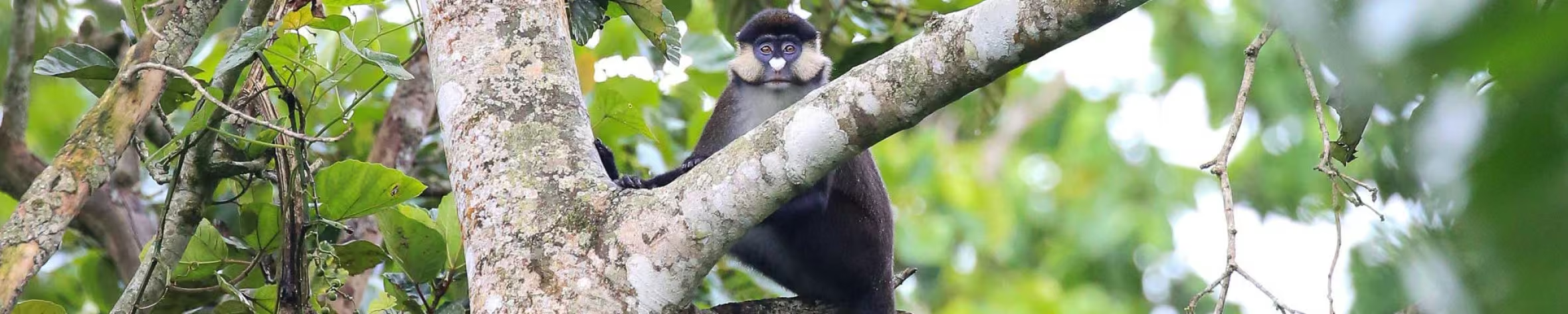
Based on my experience, you can expect to see at least 40 noteworthy bird species over the course of a swamp walk through Bigodi. This is thanks in large part to the exceptional quality of guiding. With a bit of luck, you should also encounter several of types of monkey – indeed, on my most recent visit I saw five different species, including the endangered Uganda red colobus and endemic Uganda mangabey, all within photographic range. The sanctuary is also occasionally visited by the habituated chimps for which Kibale National Park is famous, but you'd have to be very lucky to catch them on a one-off visit.
Bigodi’s emblem is the great blue turaco, a blue-green giant that grows to 75cm long and has a tall black crest and yellow-and-red bill. Almost all visitors to Bigodi see this charismatic bird, which usually moves in small flocks that glide lazily between trees. Other stellar forest-fringe birds I’ve regularly seen at Bigodi include Ross’s turaco, yellow-billed barbet, double-toothed barbet and red-headed bluebill. Part of the walk leads
Read more
through the swamp on a wooden boardwalk, and here you should look out for the elusive papyrus gonolek, which has a bold black and red torso offset by a brilliant yellow cap.Based on my experience, you can expect to see at least 40 noteworthy bird species over the course of a swamp walk through Bigodi. This is thanks in large part to the exceptional quality of guiding. With a bit of luck, you should also encounter several of types of monkey – indeed, on my most recent visit I saw five different species, including the endangered Uganda red colobus and endemic Uganda mangabey, all within photographic range. The sanctuary is also occasionally visited by the habituated chimps for which Kibale National Park is famous, but you'd have to be very lucky to catch them on a one-off visit.

Community Wetland Wander
Bigodi is a gem of a reserve that sits beside Kibale National Park, so is easily combined with a chimp trek in the latter. It comprises a small forest-fringed wetland of reedbed and papyrus swamp, surrounded by fields and farmland. A guided walk here – led by a local community member – is thus an insight into both the wetland and the community. The circular 4.5km trail allows a 2 to 3-hour circumnavigation of the wetland, with a wooden boardwalk near the end offering a taste of the otherwise impenetrable papyrus swamp.
Mammal-wise, the attraction here is primates. You’re unlikely to meet any of Kibale’s chimps – though they do occasionally visit – but you will probably encounter several monkey species. My most recent trip produced Ugandan red colobus and black-and-white colobus perched together in the same tree, plus good views of red-tailed monkey, L’Hoest’s monkey and Uganda mangabey. More elusive mammals include bushpig, sitatunga and spotted-necked otter;
Mammals, however, are not the main draw. Bigodi is a top birding destination, with 138 species recorded in less than five square kilometres, and a walk with one of the expert local guides is a chance to find many of Uganda’s more elusive forest-edge species. Great blue turacos are abundant, and you may well also see the spectacular Ross’s turaco. Other specials on my visit included red-headed bluebill, black-and-white shrike-flycatcher and hairy-breasted barbet. And while we failed to see the gorgeous papyrus gonolek – a local special – we caught a brief glimpse of a shining blue kingfisher, heard the calls of white-spotted flufftail and spied a pair of grey crowned cranes leading their fluffy hatchlings across a clearing.
Bigodi is definitely worth a visit – and for birders is a potential highlight of any Uganda trip. Wellies are recommended and are available for hire at the reserve HQ (where there are also curios for sale), but with feet as large as mine you might want to bring your own.
Mammal-wise, the attraction here is primates. You’re unlikely to meet any of Kibale’s chimps – though they do occasionally visit – but you will probably encounter several monkey species. My most recent trip produced Ugandan red colobus and black-and-white colobus perched together in the same tree, plus good views of red-tailed monkey, L’Hoest’s monkey and Uganda mangabey. More elusive mammals include bushpig, sitatunga and spotted-necked otter;
Read more
though you’d be lucky to spot any of these, larger tracks during my visit were evidence of two hippos that had recently arrived and were now hiding somewhere in the swamp.Mammals, however, are not the main draw. Bigodi is a top birding destination, with 138 species recorded in less than five square kilometres, and a walk with one of the expert local guides is a chance to find many of Uganda’s more elusive forest-edge species. Great blue turacos are abundant, and you may well also see the spectacular Ross’s turaco. Other specials on my visit included red-headed bluebill, black-and-white shrike-flycatcher and hairy-breasted barbet. And while we failed to see the gorgeous papyrus gonolek – a local special – we caught a brief glimpse of a shining blue kingfisher, heard the calls of white-spotted flufftail and spied a pair of grey crowned cranes leading their fluffy hatchlings across a clearing.
Bigodi is definitely worth a visit – and for birders is a potential highlight of any Uganda trip. Wellies are recommended and are available for hire at the reserve HQ (where there are also curios for sale), but with feet as large as mine you might want to bring your own.