
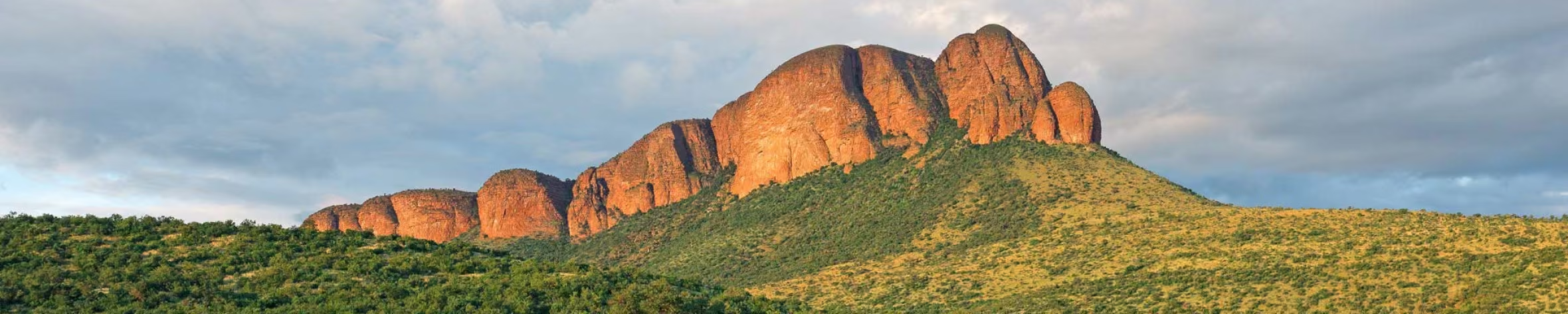
Part of the Unesco-listed Waterberg Biosphere Reserve, mountainous Marakele National Park hosts all the and its cliffs support a large colony of . The main public sector can be explored on a few gravel roads, but large mammals are scarce. The wilder Marataba sector operates as a private reserve where two small lodges offer an exclusive safari experience.
-
 Best Time To Go
- May to September (Dry season)
-
 High Season
- None (The park is little visited)
-
 Size
Size
- 670km² / 259mi²
-
 Altitude
-
983-1,986m /3,225-6,516ft
 View Photos
 View Photos
+13
Photos
View Photos
+13
Photos
 Open Map
Pros & Cons
- Beautiful rugged mountain scenery
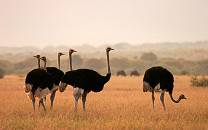
- Excellent birding
- Off-the-beaten-track destination with great wilderness appeal
- Self-catering accommodations for visitors in the public sector
- Upmarket lodge in the private Marataba sector offers good viewing
- Home to one of the world’s two largest breeding colonies
- Malaria-free
- Wildlife viewing in the public sector is erratic and predator sightings are rare
- Far away from South Africa’s main tourist attractions
- The road network is limited, and some tracks are 4x4 vehicle only
Wildlife
A variety of large mammals has been introduced into Marakele since it became a national park in 1994. Visitors to the public sector should see antelope such as , , and the rare . They might also encounter elephant, , , giraffe and , but lion, cheetah, leopard, and buffalo are scarce. Wildlife is more prolific in the Marataba sector.
More about Marakele’s wildlifeScenery
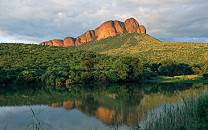
Marakele lies in the transitional zone between South Africa’s dry western and moister eastern regions. It is characterized by rugged mountain landscapes, rolling hills and deep valleys, most notably the tall sandstone for which the Kransberg (literally ‘Cliff Mountain’) is named. Botanical delights include magnificent yellowwood and cedar trees, beautiful shrubs, tree ferns and 5m-/16ft-high .
Activities
The public sector’s limited circuit of wildlife-viewing roads can be explored by in any vehicle. A scenic highlight is the narrow road up to Lenong Viewpoint, which offers good birding, with soaring overhead. Guided and are offered in the public sector. Upmarket lodge packages in the private Marataba sector include expertly guided game drives in open 4x4 vehicles, as well as boat trips and bush walks.
Weather & Climate
Marakele’s two distinct seasons will determine how you dress while visiting the park. It’ll be cool clothes in the hot summer months (October to April), but ideally with some wet-weather gear in case of occasional storms. By contrast, you’ll need lots of warm layers for the cold nights of the dry winter season (May to September).
More about the weather and climateBest Time To Visit
Despite the dusty haze that develops in the dry winter months (May to September), this is the best time to spot wildlife. Animals tend to stick close to rivers and , and even when they do duck into the , there’s less ground cover to hide them. That said, birders will want to visit in the wetter summer months (October to April), when pass through.
More about the best time to visit