
Average Expert Rating
Rating Breakdown
Write a User ReviewThe Karoo Renewed
Hot, flat and boring is how many people describe the Karoo. But for me the vastness of the landscape and the richness of its unique vegetation is what make the Karoo National Park such a great destination. It’s not the place you go to for game viewing. It’s a place you go to renew your soul. That said, SANParks has reintroduced a number of species into the park including black rhino, Cape mountain zebra and lion. As a result, low-level electrified fencing now protects the rest camp, reception complex, camping ground, swimming pool and popular fossil trail, and hiking is no longer permitted. However, there are some exciting 4x4 trails for visitors with 4x4 vehicles.

A Glimpse of the Past
This small, scenic park preserves only a tiny fraction of the immensity that was once South Africa’s Great Karoo. Nonetheless, it has a certain stark beauty and offers an excellent spectrum of wildlife, including some species that you may struggle to see elsewhere. I had an excellent aardwolf sighting on my first evening here, while guests the previous night had watched both caracal and aardvark during a single night drive (how often could you say that in, say, the Kruger or Okavango?). The attractive rest camp, with its Cape Dutch-style chalets, has a very relaxed feel and panoramic views. Black rhino and lion have been reintroduced, but this park is perhaps best known for smaller stuff – including the critically endangered riverine rabbit and five species of tortoise, the latter making it one of the world’s tortoise hotspots. Distances are small, so it is easy to explore thoroughly. Drive the loop roads to spot Cape mountain zebra and springbok grazing the scrubby plains, or climb the rocky viewpoints to look for klipspringer and Verreaux’s eagle on the pinnacles.
Worth a Stop When Road-Tripping
Most people wouldn’t plan an itinerary around the Karoo National Park, but if you’re road-tripping from Johannesburg to Cape Town, the park makes for a magnificent way to break up the drive. You need a 4WD if you really want to explore, but there is a 45km gravel road that’s perfectly doable in a sedan, plus a short tarred loop between the gate and the rest camp. Lions and black rhino have been re-introduced here, though sightings are fairly rare. You will likely spot smaller mammals though, including zebras, dassies and a range of antelope. Other than that, the semi-desert park offers often empty dirt roads, vast open skies, superlative star-gazing and a couple of day hikes close to the rest camp. Most of all, it makes a marvellous alternative to another night spent in a perfectly pretty but altogether nondescript Karoo town as you make your way across the country.
Rolling Back the Years
The Karoo once played host to one of Africa’s greatest wildlife spectacles: the annual springbok migration, but uncontrolled hunting and rapid expansion of the sheep farming industry put an untimely end to this natural phenomenon many years ago. The Karoo National Park offers us a rare glimpse back to a bygone era and I find the park provides a strong sense of what the wider area must have been like a century ago.
The sparse vegetation in this low rainfall area ensures wildlife cannot hide and some of my best animal sightings having taken place on the Lammertjiesleegte route on the plains, while the scenic drive up the pretty Klipspringer Pass to the viewpoint at Rooivalle is well worth the effort. I have also found that it is the 4x4 only areas deeper inside the park that tend to be most productive for lion sightings. Many of the park’s other species are harder to observe due to their shy nature and nocturnal habits in this sun-baked national park.
A Blast From the Past
Strange beasts, such as big-headed herbivorous dicynodonts and wolf-like predatory therapsids, roamed these wetlands, chewing on papyrus, or else on each other, in the eternal circle of life.
These creatures have long since disappeared, supplanted by dinosaurs, who were eventually succeeded by modern birds and mammals. But they left behind evidence of their existence through fossils, thousands of which have been discovered within this 768-square-kilometer park.
You can see many of them on display alongside a 400m fossil trail situated close to the park’s rustic Dutch colonial-style accommodation camp.
These days, there are obviously no living prehistoric creatures to be seen in the Karoo National Park, but a guided hike or a game drive might very
Read more
well lead to an encounter with a black rhino, lion, or brown hyena.I don’t really come to the Karoo for the wildlife though. It’s the big open scenery, the clear starry nights, and the sense of isolation and peace that makes places like this so incredibly special.
Wildlife & Fossils
The small park gives an insight into how South Africa’s vast Karoo once was, before humans transformed the land and killed all the animals. Wildlife densities aren’t big, but the open scenery makes it easy to spot quite a wide variety of creatures. We saw small herds of Cape mountain zebra, black wildebeest, gemsbok, red hartebeest and several klipspringers. Lion, black rhino and buffalo have been reintroduced, but we didn’t manage to see any of these flagship species. Night drives are very rewarding with a chance of seeing aardvark and other nocturnal specials rarely seen elsewhere, such as Cape fox. There is some interesting birdlife too and we were happy to spot Verreaux’s eagle, which is known to breed in the
Read more
park. Even if you don’t have time for a game drive, it is worth checking out the educational Fossil Trail near the entrance. This outdoor museum brings back to life the extinct wildlife that lived in the Great Karoo a staggering 255 million years ago.Sea of Fossils
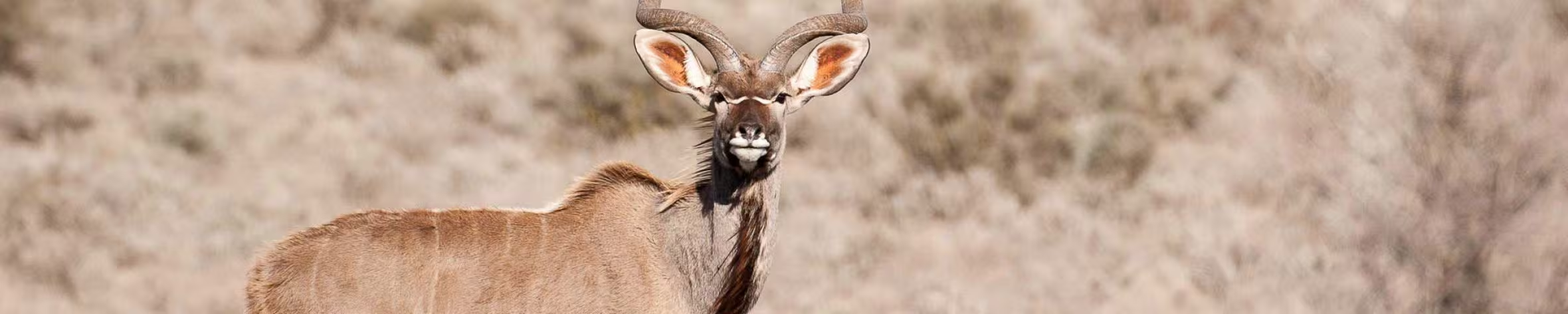
A short all-vehicle road network leads from the entrance and rest camp through wonderful desert rockscapes associated with the Nuweveld Mountains, but a 4x4 is required to travel deeper into the park. Common wildlife includes Cape mountain zebra, gemsbok, red hartebeest, greater kudu, springbok and klipspringer. If you are seeking the Big Five, be warned that while leopards occur naturally, and lions, buffalos and black rhinos have all been reintroduced, none of them is very likely to be seen on a short visit. An avian highlight is the 20-odd pairs of Verreaux’s eagle that breed
Read more
on the cliffs and are often seen soaring above them. More obscurely, the park also forms the major stronghold for the Critically Endangered riverine rabbit, a Karoo endemic with a wild population of fewer than 500 individuals.A good logistical reason to include Karoo National Park in your itinerary is that its attractive rest camp makes for an excellent overnight break when you drive along the N1 between Cape Town and Johannesburg.