
Average Expert Rating
Rating Breakdown
Write a User ReviewBlooms and Canyons
Timing is everything when it comes to desert plants. Rainfall here is rare and unpredictable, and most species lie dormant for much of the year. The best chance to see the flora at its finest is in August and September, when winter rains usually trigger a short-lived burst of flowering across the region. Unlike the dense, colourful daisy fields associated with Namaqualand, the |Ai-|Ais/Richtersveld reveals its beauty in miniature. Tiny succulents and delicate blooms appear between stones and on rocky ledges – often missed unless you stop and look closely.
Even outside
Read more
the flowering season, the park remains compelling. Wildlife densities are low and large mammals are seldom seen, but the landscapes are unforgettable. From the South African side, dramatic mountain ranges, steep passes and broad gravel plains dominate the scenery, giving the Richtersveld its reputation for stark, untamed beauty.Across the border in Namibia, the |Ai-|Ais section is equally dramatic, though different in character. Here, the towering Fish River Canyon and the famous hot springs create a rugged but more accessible environment. Visitors can relax at the |Ai-|Ais resort or explore the canyon’s edge.
A 4x4 is recommended throughout the transfrontier park, but I managed fine with a high-clearance SUV.

Land of the mutant plants
The most magnificently isolated of South Africa’s national parks lies on the remote Namibian border formed by the Orange River. It is by no means a conventional safari destination, and is accessible by 4x4 only, and then only after a two day drive from Johannesburg or Cape Town. The main attraction of the region is its ragged scenery and unique vegetation, supporting as it doe some of the most peculiar of the 3,000 plant species endemic to the Karo biome. These include the succulent quiver tree and bulbous halfmensboom, whose name – literally half-human tree – refers to a traditional belief that it is half-plant and half-human. Typical dry-country antelope such as gemsbok, springbok and klipspringer are likely to be seen, and the area supports a number of birds endemic to the arid west of South Africa and Namibia, but it must be emphasised that the park’s remoteness and wilderness feel are its primary attractions, not the wildlife.
An Arid Place for Landscape Lovers
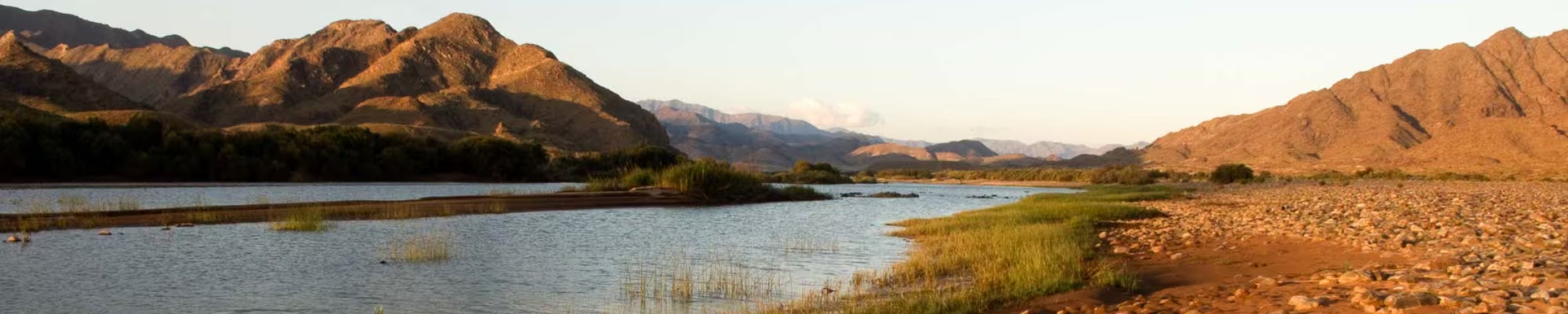
There are two main ways for visitors to experience and explore the park’s rugged beauty and dramatic landscapes. A series of adventurous 4x4 routes wind their way through the parched Richtersveld on the South African side, but, personally, I like exploring this desolate park by river. South Africa’s longest waterway cuts through a geological paradise and visitors have a chance to join 4-, 6- or even 8-day fully-catered canoe safaris. You will negotiate a series of minor rapids as you paddle and drift beneath contorted mountains, deep canyons and bizarre rock formations at every turn.
The Richtersveld contains a treasure-trove of endemic desert flora that survives in some of Africa’s most beautiful geological landscapes, but this is certainly not a place for avid wildlife enthusiasts to frequent, as few large mammals survive in this harsh and unforgiving environment, and those that do tend to stick to the Namibian side of the transfrontier park. So,
Read more
while you’re unlikely to come across any of the Big Five during a visit here, you will experience a wilderness vibe and geological masterpiece second to none.NAMIBIAN PART
Few landscapes on earth can rival the /Ai/Ais-Richtersveld Transfrontier Conservation Area for enormity, arid beauty, sizzling sunshine and a feeling of absolute desolation. For decades, the park was the exclusive domain of a handful of experienced 4x4 enthusiasts and hot spring visitors, but more recently a new breed of explorer has taken to conquering the rocky desert on foot and bike.
The lack of dangerous wildlife has prompted some extreme events to take hold and cater for privileged few energetic adventure seekers wanting to explore more than just the Fish River Canyon hiking trail and /Ai/Ais hot springs.
Quite likely the only wildlife you’ll see during your visit is the endemic Hartman’s mountain zebra, along with oryx, kudu, springbok and baboons, but leopard spoor is common and /Ai/Ais-Richtersveld is an ageless and primordial landscape like no other. Sitting around a desert campfire, the night sky dripping with a billion stars, the sense of remote, ancient wilderness is intoxicating.
Desolation and Grandeur at the Fish River Canyon
Although limited wildlife is present in the park, it is not often seen – the main reason to visit is to take in the natural wonder of the canyon, the clear night skies and the nearby |Ai-|Ais Hot Springs. That said,
Read more
especially if you are hiking, you may well see various lizards and occasionally snakes, plus some beautiful sightings of falcons.The South African side is known for being home to about one-third of South Africa's succulent plant species, plus some rugged driving and hiking routes. A good way to get a feel for the park without undertaking a full 4WD expedition is staying a night or two at the newly renovated Sendelingsdrif rest camp. Depending on river levels, you can cross the Namibian–South African border here via pontoon ferry, but check first with SANParks whether it is operating.
A surreal rugged and barren landscape best known for the dramatic Fish River Canyon
Combining South Africa’s Richtersveld National Park, and Namibia’s Fish River Canyon and Ai-Ais Hot Springs, this park spans a spectacular arid and rocky desert of sharp gravel. A host of cacti, succulents and kokerboom (quiver) trees survive, but there are very few animals. The easiest and most popular access point is Namibia’s Hobas viewpoint on the western rim of the Fish River Canyon; I’ve watched some amazing sunsets here and the switch-back tortuous curves of the Fish River at the bottom never fails to impress. I’ve also enjoyed the Ai-Ais hot springs resort by the riverbed at the southern end, and visits to both give a combined experience of what is a dramatic huge gash in the earth. The South African section of the park is a rough and hot mountainous region (fully-equipped four-wheel-drive only), but where the highlight is the Orange River which slips silently between the parched peaks.
Epic Mountain Desert
Definitively remote and wild, |Ai-|Ais/Richtersveld covers 6000 sq km of mountain desert, on both sides of the South Africa-Namibia border. In this harsh land, you won't find the Big Five lapping at waterholes, but you may spot a rare leopard or caracal, brown hyena or black-backed jackal. The main reason to visit this extreme corner of southern Africa is the unique landscape, in which the Orange River runs between bone-dry mountains and the world's largest desert fauna. In this surreal environment, early-morning fog rolls in from the cold Atlantic, curling around quiver trees, tall aloes and Halfmens trees.
|Ai-|Ais/Richtersveld is only accessible by 4WD, and it's worth scheduling a week here, as even the sturdiest Toyotas move slowly. Guided hiking trails and accommodation in campsites, chalets and cabins are offered on the South African side of the park, which covers 163,000 hectares south of the Orange River.