5 Fascinating Facts About the African Rock Python
 By
Mike Unwin
By
Mike Unwin
Mike is an award-winning wildlife writer, former editor of Travel Zambia magazine and author of the Bradt Guide to Southern African Wildlife.
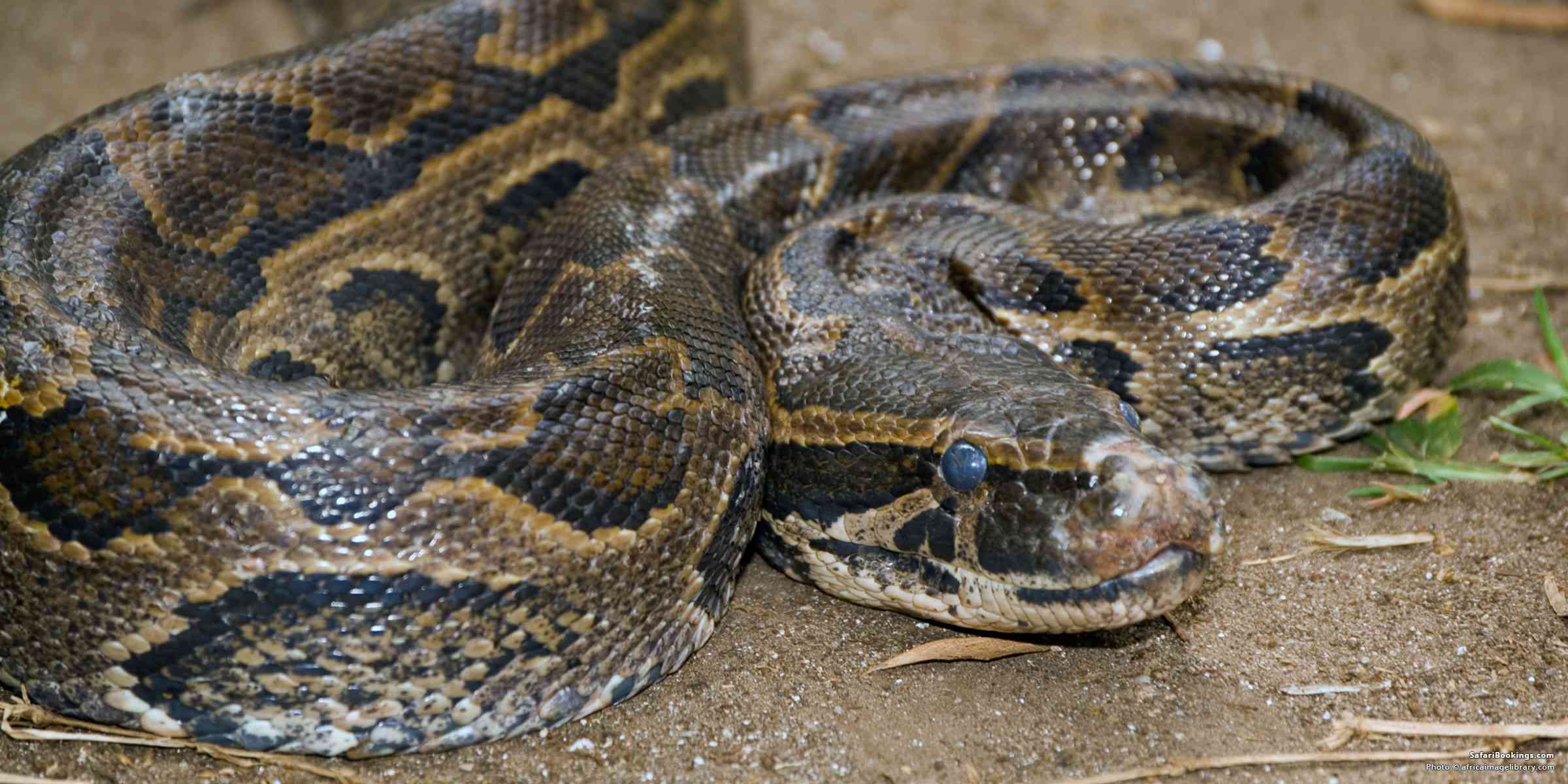
Suffer from ophidiophobia – or fear of snakes? If you do, avoid the African rock python (Python sebae), Africa’s largest serpent. This python, spanning a length of up to six metres, is able to attack (and even start to swallow) a human being. Luckily, such incidents are extremely rare. Truth be told, this formidable reptile is one of the most fascinating creatures to meet on safari. Below are five fascinating facts about the African rock python.
- Like all pythons, this snake is non-venomous. It kills by constriction, ambushing and coiling around its prey, and tightening its coils every time the victim breathes out. Death happens by cardiac arrest, rather than by asphyxiation or crushing.
- African rock pythons feed on everything from birds and bats to medium-sized mammals. The larger python captures warthogs, bushbucks and even crocodiles, swallowing them whole. Poultry, dogs and goats are also at risk of attack. A huge meal takes months to digest.
- African rock pythons lay 20–100 hard-shelled, elongated eggs in an old animal burrow, termite mound or cave. The female coils around her clutch, protecting them from predators and possibly helping to incubate them, and guards the babies for up to two weeks after hatching.
- Pythons are among the most primitive of snakes in evolutionary terms. With two functioning lungs (more advanced snakes have only one) and small thorn-like projections on the lower body. These are known as pelvic spurs, which are presumed to be the vestiges of hind limbs.
- Scientists recognize two subspecies of the African rock python: Python sebae sebae (African rock python) and the slightly smaller Python sebae natalensis (Southern African rock python). The smaller Python sebae natalensis, is found in southern Tanzania and further southward, and is believed to be a completely separate species: Python natalensis.
Want To Go on an African Safari?
Click on the button below to compare African safaris offered by top-rated tour operators.
By
Mike Unwin
Mike is an award-winning wildlife writer, former editor of Travel Zambia magazine and author of the Bradt Guide to Southern African Wildlife.
More About This Author

 Subscribe to our newsletter
 Follow us on Instagram
African Safari Tours
-
![3-Day Serengeti National Park & Ngorongoro Best Safari]()
3-Day Serengeti National Park & Ngorongoro Best Safari
$1,331 pp (USD)
Tanzania: Private tour
Mid-range Lodge & Tented CampYou Visit: Arusha (Start), Serengeti NP, Ngorongoro Crater, Arusha (End)

Serengeti Silence
5.0/5 – 147 Reviews

-
![4-Day Luxury Romantic Honeymoon Safari in Tanzania]()
4-Day Luxury Romantic Honeymoon Safari in Tanzania
$2,114 to $2,165 pp (USD)
Tanzania: Private tourLuxuryLodge & Tented Camp
You Visit: Arusha (Start), Tarangire NP, Serengeti NP, Ngorongoro Crater, Arusha (End)
Josh Dreamland Safari
4.9/5 – 111 Reviews
-
![9-Day Unique Honeymoon Safari & Zanzibar Beach Vacation]()
9-Day Unique Honeymoon Safari & Zanzibar Beach Vacation
$3,656 to $4,016 pp (USD)
Tanzania: Private tourLuxuryLodge & Tented Camp
You Visit: Arusha (Start), Tarangire NP, Lake Manyara NP, Ngorongoro Crater, Serengeti NP, Nungwi (Zanzibar), Zanzibar Airport (End)
African Big Cats Safaris
5.0/5 – 728 Reviews