
 Google Maps


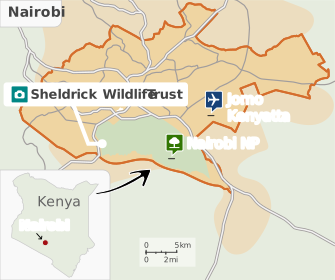
Tucked away in a back corner of Nairobi National Park, Sheldrick Wildlife Trust is one of Nairobi’s most memorable attractions. Here at this elephant orphanage, you’ll get to hang out with baby elephants, watch them feed,
Read more
and hear their stories. It’s a place with a fascinating history and a serious conservation message, quite apart from being a whole lot of fun. To make this work, you must address one important detail: you can only attend if you book online and in advance.-
1
Arrive at the Trust
Entrance to the elephant orphanage This is one of the most popular things to do in Nairobi, but the message hasn’t quite reached the visiting public yet: advance bookings are essential. You’ll discover this when you arrive at the back entranceRead more
to Nairobi National Park, off Magadi Road in Nairobi’s southwest. You’ll be asked for proof of your booking first by the rangers at the gate, and again a few hundred meters farther on at the entrance to the car park. Assuming you have booked online before you arrive, keep in mind that weekends are especially busy, so get there early to avoid the slow-moving queue as reservations are checked.Once you park the car, head straight for the gate, which opens at 11 AM sharp. When that happens, be ready to move quickly (some people even run) down to the viewing area to get a front-row position at the rope line. The elephants will appear here soon after you do. Given that the elephants move around freely, the better the position you get, the closer you’ll be to the elephants. -
2
Watch the Elephants Arrive and Feed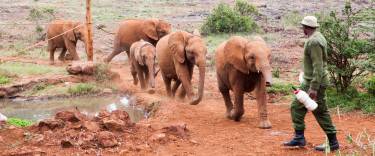
Baby elephants arrive at the play area The elephants begin to appear, as if out of nowhere. Every morning, their keepers take them out into the nearby forest before they come to their play area (where you’re waiting) to be fed. These areRead more
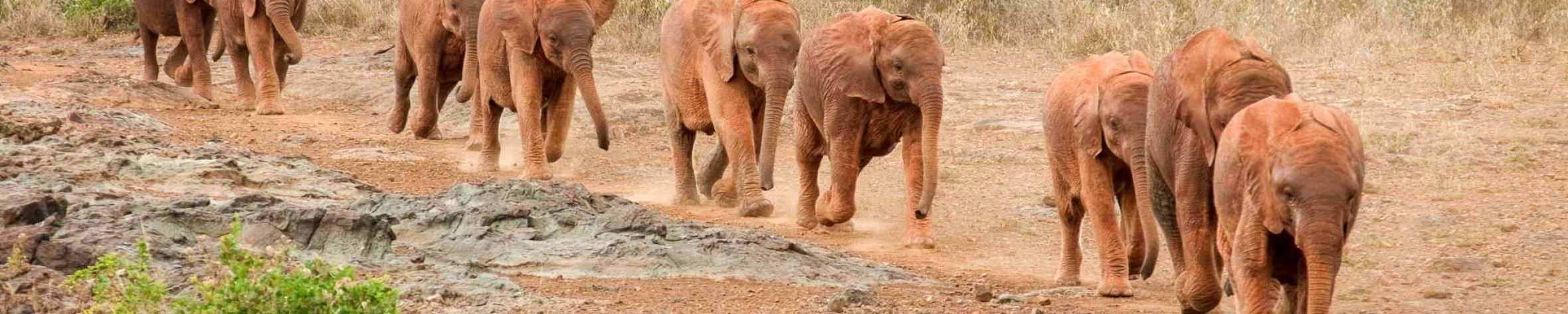
the youngest of the orphans, and they really are miniature elephants. As they emerge from the bushes, some of them break into a run – there is nothing cuter in the animal kingdom than an excited baby elephant. Usually numbering 10 to 15 individuals, the young orphans each have a keeper waiting for them with a bottle filled with milk formula, which the elephants hungrily drink, finishing in seconds.Once they’re fed, they are free to move around the area. Some pull the leaves off the branches that have been strewn around the area, while others roll playfully in the mud. Others wander off on their own, and a few gather in groups of three or more to plan some mischief. Very often, they wander over to the rope where you can reach out and touch them. It really is a magical scene. -
3
Learn the Elephants’ Stories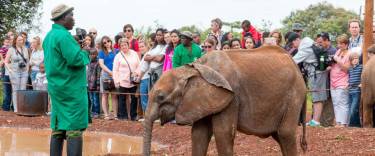
The head keeper gives the introduction As you will already have seen, each of the orphaned elephants has its own personality. And while the elephants play and wander around, the head keeper tells each orphan’s story – where and how they wereRead more
rescued, their age and name, and a little about their personality. Each is a fascinating window on the story of elephants in Kenya – some were rescued after falling down a well, others got left behind by their herd, and still others were left to fend for themselves when their mothers were killed. The keeper will also talk about the history of the Trust. Founded in 1977, it has raised more than 315 orphans to adulthood, and its anti-poaching work continues across the country.When the younger orphans have had their time in the spotlight, the keepers lead them away, and soon the slightly older elephants arrive. These are the teenagers of the Trust, and they can be a boisterous and confident crew. The same process is repeated – bottle-feeding, then playtime and mud baths while their stories are told. Then they, too, are led into the forest to pass the day learning to be wild elephants in preparation for their transition back into the wild. -
4
Adopt an Elephant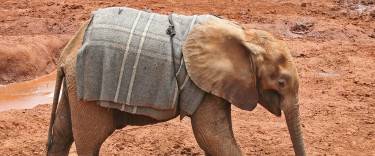
Orphaned elephant calf As the older elephants depart, which usually happens close to midday, the crowds start to disperse and return to their cars. Consider stopping on your way to the exit at the small open-air gift shop. AlongsideRead more
branded souvenirs and crafts, you can read through the portfolio of elephants available for adoption. For just US$50 a year, you can support the work of the Trust. In return, you’ll receive a hand-drawn picture and a photo of your elephant, a certificate of adoption, and monthly online updates about your orphan’s progress.There’s no pressure at all to adopt. But if you do, following the story of your individual elephant is a great way to get a deeper, more personal connection with the hope-filled story of elephant conservation in Kenya.


Nearby Attractions

The most obvious add-on to a visit here is Nairobi National Park. Although the Sheldrick Wildlife Trust lies within the park’s boundaries, there are separate entrances only a few hundred meters apart along Magadi Road. Each