
Average Expert Rating
Rating Breakdown
Write a User ReviewOn the Rocks
I also saw causes for concern, though. More cattle were grazing within the park than I’d previously seen and large areas had been recently burned – both signs of uncontrolled incursion from the local community. I also saw fewer grazers (zebra, impala and wildebeest) than in the past, which may reflect these issues.
Happily, smaller mammals, including klipspringer, baboon and rock hyrax, remained abundant, while birding was as good as ever. Matobo has Africa’s highest known concentration of breeding Verreaux’s eagles: as well as seeing several pairs
Read more
of these impressive raptors, my sightings of Wahlberg’s eagle, African hawk-eagle, martial eagle and brown snake eagle, helped confirm the park’s excellent reputation for raptors.Dambari, a local conservation NGO, confirm that community incursion is an ongoing problem and that numbers of some large mammals have declined; sable, once a Matobo special, may now have disappeared. However, their recent camera trap surveys have also captured images of species – including spotted hyena, African wild dog and even elephant – that had barely, if ever, been previously recorded. Many of these will just have been passing through, but they nonetheless offer evidence of the park’s great importance for conservation.
Either way, the Matobo’s other-worldly landscape of balancing stones and granite whalebacks continues to offer a fabulous natural playground for the independent traveller, whether on foot or by vehicle. Accommodation options include a national park rest camp, plus several private lodges that offer guided activities. The park is easily visited on a day trip from nearby Bulawayo, Zimbabwe’s second city, but you really need to stay over for at least a couple of nights to appreciate its unique appeal.
Game viewing remains best in the 105km2 Whovi Wilderness Area, a separate fenced zone boosted by restocking. Here you can see both white and black rhino, plus hippo, giraffe, zebra and a variety of antelope. Elsewhere you may encounter game in smaller numbers, with the highlight being white rhinos, which you can track on foot with a parks guide. There are no lions, elephants or buffalo, and leopards, though plentiful, are seldom seen. Birdlife is rich – as is reptile life, including colonies of colourful flat lizards, plus rock pythons and black mambas.
And it’s not all about wildlife. Along well-marked trails you’ll also find caves adorned with ancient rock art, and at World’s View you can appreciate the park’s stunning panorama from beside the grave site of controversial colonial Cecil John Rhodes, while looking out for a confiding boulder chat or one of the delightful rock elephant shrews that dash between crevices in the granite.
My fingers are firmly crossed that this extraordinary place can manage its security, whilst working with the local community, so that such treasures remain in perpetuity.

Granite Whalebacks and Invisible Leopards
He wasn’t wrong.
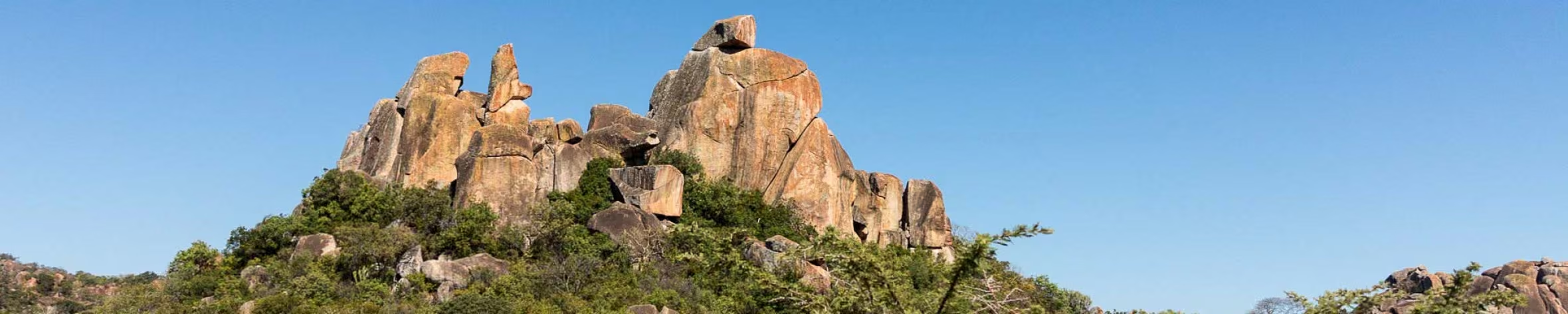
The smooth granite hills that typify Matobo are easy to walk upon, and the scenery is to die for (especially if one gets too close to some of the precipitous drop-offs). Impossibly poised boulders, some as large as houses, sit like ill-balanced eggs atop rounded domes, which are, in turn, surrounded by grasslands and forests. The larger specimens are known as whalebacks because, well, they look like pods of whales arching out of a sea of trees.
My wife and I sat upon one of these, beneath the shadow of a huge split boulder, and watched the African sun disappear below a horizon cluttered with bizarre and wonderful rock formations. A big troop of baboons were going berserk on the dome opposite us, probably because they had seen a leopard on the prowl, but alas, even
Read more
though Matobo is reputed to have one of the largest densities of these cats in all of Africa, they are seldom observed by people. I’ve been to this park numerous times, and the most I’ve seen of them are their footprints and scats.Although the leopards might well be elusive, the grand scenery of Matobo is always on full display. Be it the numerous geological formations (some of which sport ancient rock paintings) or the lovely lakes and forests, you’ll be hard-pressed to find anywhere else quite so beautiful in all of Zimbabwe.
Wildlife can be a bit thin on the ground. There is a specially guarded section of the park where rhinos can be seen, but you won't encounter lions or elephants at all.
Birding is great though, and you’ll also have the opportunity to spot common game such as zebra, kudu and eland. Klipspringers and rock hyrax are two a penny.
Cecil John Rhodes (after which Rhodesia, now Zimbabwe, was named) is buried on a prominent lookout atop one of the largest hills of Matobo. Even if you don’t feel like paying homage to such a divisive colonial figure, the views alone make it well worth the climb.
Ancient Hills in the Heart of Matabeleland
I felt a strong spiritual presence when visiting the dwalas, or eroded granite kopjes, of the Matopos. Many others, apparently, feel the same; some of the dwalas appear precariously balanced, as if held in place by supernatural forces, and the rock art that adorns their caves hints at age-old secrets. Coloured grey, pink, ochre and gold by swathes of lichen, there’s an appealing, sculptural quality to the formations. I scrambled up a couple of them to admire the view of the surrounding bushland, which has been stocked with white rhinos – rangers will take you out on a tracking expedition on request.
The park was very quiet when I visited – it was just me, my guide and a couple of soaring eagles – but for me, that only added to the atmosphere.
Iconographic Zimbabwean Scenery With Its Stunning Kopjes
More than just a wonderful scenic spot or a wildlife refuge, Matobo National Park is one of the cultural highlights of Zimbabwe. It should in fact be considered one of the world’s ‘power places’ – right up there alongside Great Zimbabwe Ruins as an African counterpart to Machu Picchu and Angkor Wat! Trek in Matobo and you will see great troops of baboons (and perhaps the leopards that feed on them). Fantastic eagle sightings await, too. But there are also ancient lookouts and fortifications, and the storage areas and forges where the warriors of Lobengula once made their fearsome assegais. In this park lies not only the ancient ‘Rain Shrine’ of the Ndebele but also the grave of Cecil Rhodes, who asked to be buried here on what he called ‘the view of the world’. Rhodes was a realist – I guess he figured that if he was going to have to spend eternity in one spot, he might as well give himself something interesting to look at!