

 Google Maps


The Serengeti National Park is one of the world’s most exciting ballooning sites. For one, it is only from the air that the vast scale of this national park’s endless plains can be fully appreciated. The
A balloon safari can be booked by your tour operator as an add-on to your Serengeti safari.
Read more
experience is also staggeringly beautiful, not least because balloons launch at sunrise, when the light can be gorgeous. Then there’s that wildlife: lions, giraffes, elephants, wallowing , large herds of buffalo, and so on. And should you be fortunate enough to catch the Serengeti’s on the move, there’s truly no better way to see this dramatic phenomenon.A balloon safari can be booked by your tour operator as an add-on to your Serengeti safari.
-
1
Pre-dawn Drive to the Launch Site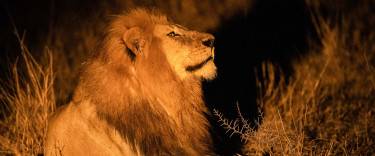
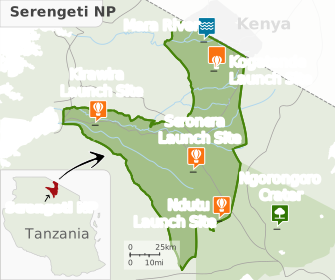
Animals active at night can be seen on the drive There are four balloon launch sites in the Serengeti. The Seronera site operates year-round, while the other three are seasonal and follow the . Whichever launch site you use, the drive there will be anRead more
adventure in itself. Depending on how far you need to travel from your lodge or camp, you’ll most likely set off between 4:30 AM and 5:30 AM, long before sunrise.And while the temptation to snatch some extra sleep might be strong, it’s worth staying alert in case you encounter wildlife. Large carnivores such as lion, leopard or are most active by night, as are the smaller likes of , or , and it is also when are most often seen grazing on land. Even if you miss out on the wildlife, the drive provides a great opportunity to experience the African by moonlight or starlight. -
2
Coffee and Briefing as the Sun Rises Over the Launch Site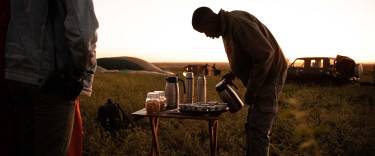
Coffee being served on arrival at the launch site A purple hint of predawn light should be visible on the eastern horizon as you arrive at the launch site. It will probably still be quite chilly though, so you’ll be glad if you brought alongRead more
some warmish clothes. While the crew starts preparing the balloons for takeoff, you’ll be offered a cup of coffee and a biscuit, as well as the opportunity to use a makeshift bush toilet. Once everyone is assembled, each balloon captain will give their group of up to 16 clients a safety briefing. They also allocate positions in the basket and explain how to sit during takeoff and landing. -
3
Takeoff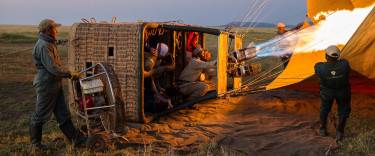
Preparations for takeoff The final stage of preparation involves heating up the air inside the balloon using an industrial-size air heater and fan. This might take some time, as a seriously large balloon is required to carry a 16-seaterRead more
basket. There’s a mounting sense of excitement as the balloon expands, while sporadic blasts of hot air cut through the early morning chill, and the basket starts to twitch in anticipation of another takeoff.The balloon will still be on its side when you board. Passengers allocated to the top row must clamber in first, lying backwards in a sitting position, and strapping themselves in with daypacks clutched tightly on their laps. They are then followed by the bottom-row passengers.Once everybody is safely in position, the captain will shoot a few last blasts of hot air into the balloon, causing it to rise and turn the basket upright. Then it’s just a case of waiting for the instruction to stand, and you’ll find yourself gliding silently above the endless plains as the sun rises orange on the horizon. It’s a magical moment. -
4
The Balloon Trip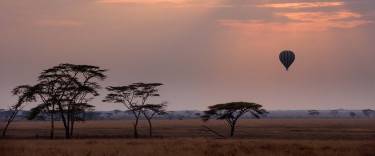
Hot-air balloon safari at dawn Serengeti National Park, Tanzania. Photo by Ariadne van Zandbergen. © All rights reserved 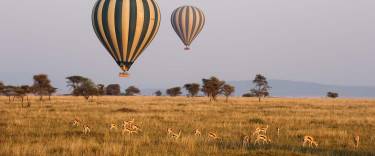
Hot-air balloons flying over Thomson's gazelles Serengeti National Park, Tanzania. Photo by Ariadne van Zandbergen. © All rights reserved 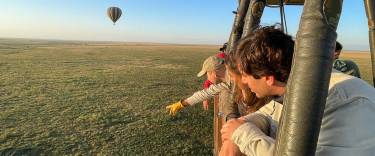
Wildlife viewing from a balloon Serengeti National Park, Tanzania. Photo by Ariadne van Zandbergen. © All rights reserved 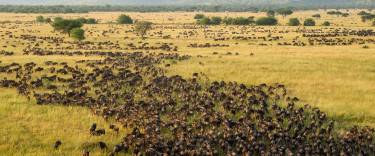
Looking down on the wildebeest migration Serengeti National Park, Tanzania. Photo by Ariadne van Zandbergen. © All rights reserved 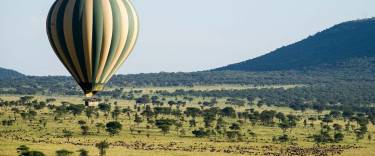
Floating above the wildebeest migration Serengeti National Park, Tanzania. Photo by Ariadne van Zandbergen. © All rights reserved 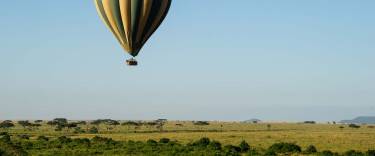
Flying over the Serengeti plains Serengeti National Park, Tanzania. Photo by Ariadne van Zandbergen. © All rights reserved 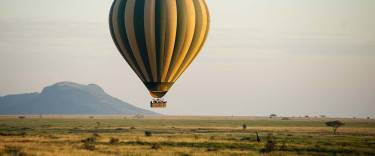
Flying over the Serengeti plains Serengeti National Park, Tanzania. Photo by Ariadne van Zandbergen. © All rights reserved 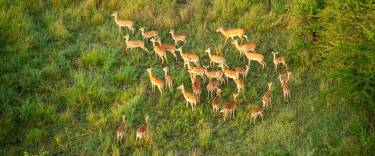
A herd of impalas seen from the air Serengeti National Park, Tanzania. Photo by Ariadne van Zandbergen. © All rights reserved 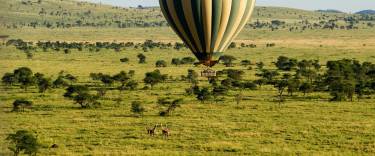
Flying over a herd of giraffes Serengeti National Park, Tanzania. Photo by Ariadne van Zandbergen. © All rights reserved 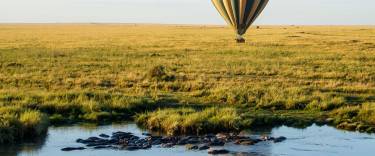
Flying over a hippo pod Serengeti National Park, Tanzania. Photo by Ariadne van Zandbergen. © All rights reserved Wow! Wow! And wow again! That’s most people’s reaction during the first few minutes of a Serengeti balloon ride. See the grassy plains as they stretch toward a distant curved horizon; the scattering of isolated rockyRead more
hills bathed in golden light; the meandering rivers fringed by jungle-like ribbons of . It really is breathtaking.Wildlife viewing can be amazing too. Elephants and buffalo, so large and imposing when seen from the ground, look toy-like as they march quietly across the plains. You might see a lion, leopard or startle from the undergrowth, a nervous crash into the water, a herd of curious giraffes craning their necks at the strange object floating above them, or troops of and sunbathing high in the treetops.Unfortunately, one thing you cannot take for granted on a Serengeti balloon ride is catching the in action. That said, time things right – fly from Ndutu in February, Kirawira in June, or Kogatende in August – and you stand a pretty good chance of seeing wall-to-wall and zebra on the plains below. Even if you don’t, a Serengeti balloon ride registers a full 10 on the wow-factor scale! -
5
A Champagne Landing
Opening champagne after landing Coming back to Earth at the end of a balloon ride might sound slightly anticlimactic. In fact, it’s one of the most exciting parts of the experience. As you descend close to the ground, the captainRead more
will instruct you to pack away any cameras or other loose items, then at the last minute they’ll tell you to resume a seated position. In perfect weather conditions, a skilled and lucky captain might land you upright, but more often than not the basket will turn back on its side, bumping raggedly over termite mounds and shrubs as it grinds to an unwilling halt. This can be a little unnerving, but it’s very safe and part of the ballooning experience.As you clamber out, you’ll be greeted by a grinning ground crew holding a rack of glasses and several bottles of cold bubbly for a customary toast. This is a tradition that dates back to the late 18th century, when the first pioneering ballooners always carried a champagne as a peace offering to any agitated farmer on whose land they happened to land. Cheers to that! -
6
Bush Breakfast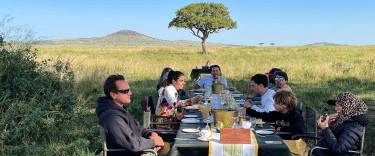
Breakfast in the bush The adventure isn’t quite over yet! Once you’ve downed your champagne, you’ll bundle into a 4x4 vehicle and head for a bush breakfast, possibly finding it hard to believe that after all this excitement, it’s stillRead more
not much after 7 AM. The breakfast is a delight in itself, with several large tables set out in an isolated patch of as uniformed chefs and servers ply you with coffee, juice and a drop more champagne. Although it’s traditional to enjoy a full English breakfast after a balloon ride, you will also be offered a vegetarian option.It’s not unknown for wildlife to make an appearance during the meal. Indeed, on one memorable occasion many years ago, our post-ballooning breakfast was interrupted by a pair of male lions strolling past. But the crew are used to this and know how to keep their clients safe. And even if you don’t see wildlife over breakfast, you’ll still be finished early enough in the day to enjoy a productive as you head back to your lodge or camp.


Practical Info
- Serengeti hot-air balloon safari prices
-
The cost of a shared balloon safari in the Serengeti will be around US$600 per person. This includes transfers between your camp or lodge and the launch site, and a champagne breakfast, but it doesn’t include
Read more
park entrance fees. Private balloon safaris can also be arranged but they are a lot more expensive. - Book well in advance
-
You are strongly advised to book your balloon safari in advance, as capacity is limited and the balloons are often full in high season. This can be done through any safari operator. If you arrive without
Read more
a booking, you can check for last-minute availability at the Serengeti Balloon Safari office in the visitor center at the Seronera park headquarters. - What to wear and bring
-
The Serengeti is often surprisingly chilly in the early morning, but it tends to warm up by 9 AM or so. Ideally you want to be wearing long trousers, a long-sleeve shirt and closed shoes, and
Read more
it’s definitely worth bringing a jacket, sweater or windbreaker. A hat and sunglasses are also recommended for later in the morning. It is fine to bring cameras, phones, binoculars and so on, but do make sure they’re packed up in a bag for takeoff and landing. - Which launch sites are used and when
-
There are four main balloon launch sites in the Serengeti. The most established launch site lies close to the Seronera park headquarters in the central Serengeti and operates throughout the year. The other three sites are
Read more
seasonal. Balloons launch from Ndutu in the southeast over late December to March, from Kirawira in the Western Corridor over June to October, and from Kogatende in the far north over July to mid-November.
Although wildlife viewing can be unpredictable, Seronera is generally quite good all year round. The other three sites essentially follow the , so they tend to be very good during their season of operation. Your choice of launch site will depend on which lodges and camps you are booked into. You generally need to be within about an hour of the launch site.