5 Fascinating Facts About Cape Porcupine
 By
Mike Unwin
By
Mike Unwin
Mike is an award-winning wildlife writer, former editor of Travel Zambia magazine and author of the Bradt Guide to Southern African Wildlife.
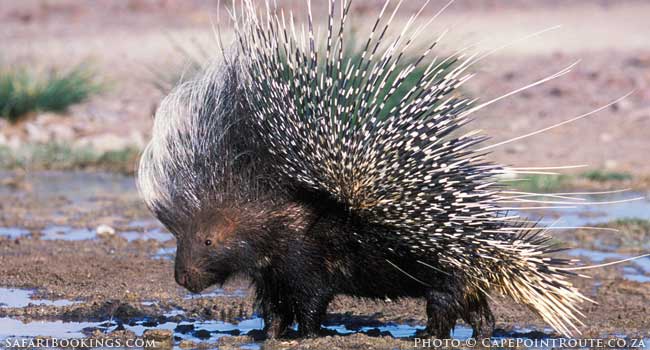
The Cape porcupine (Hystrix africaeaustralis) grows up to a meter long and 20kg in weight. This is the world’s largest porcupine – and also by far the largest rodent in Africa. However, these dimensions are not as impressive as the sight of the animal itself. It's a vision to behold as it trundles along, beneath a quivering battery of spines – like a bush on legs. And a bush to avoid!
Indigenous to South Africa, the Cape porcupine can be seen near vegetation at sea level to 2000m above sea level, usually in rocky hill areas. Furthermore, if you see one, enjoy the view from afar. You won't want to get too friendly with these prickly creatures! Below are five interesting facts about the Cape porcupine.
- All porcupines (and the Cape porcupine is no exception) have banded quills which are essentially their hairs. Those on the back may be 40cm long; the shorter, open-ended tail quills will rattle as a warning.
- Contrary to popular myth, a porcupine’s quills will not fire at enemies but rather will loosely embed in their skin and they easily shed on contact. When threatened, a porcupine erects its quills and backs towards its assailant. Consequently, careless predators may end up with quills so deeply embedded that fatal wounds can develop.
- Porcupines feed on roots, bulbs and bark. As a result, their habit of fatally ring-barking trees has a significant ecological impact because it helps open up woodland into savanna.
- Porcupines often gnaw bones because they need their minerals and also to sharpen their powerful incisors.
- Porcupines form monogamous pairs, which mate throughout the year. The male plays an unusually active role in raising the litter of 2–4 young. Each pair may inhabit up to six burrows and jointly defend its shared territory.
Want To Go on an African Safari?
Click on the button below to compare African safaris offered by top-rated tour operators.
By
Mike Unwin
Mike is an award-winning wildlife writer, former editor of Travel Zambia magazine and author of the Bradt Guide to Southern African Wildlife.
More About This Author

 Subscribe to our newsletter
 Follow us on Instagram
African Safari Tours
-
![3-Day Serengeti National Park & Ngorongoro Best Safari]()
3-Day Serengeti National Park & Ngorongoro Best Safari
$1,331 pp (USD)
Tanzania: Private tour
Mid-range Lodge & Tented CampYou Visit: Arusha (Start), Serengeti NP, Ngorongoro Crater, Arusha (End)

Serengeti Silence
5.0/5 – 147 Reviews

-
![4-Day Luxury Romantic Honeymoon Safari in Tanzania]()
4-Day Luxury Romantic Honeymoon Safari in Tanzania
$2,114 to $2,165 pp (USD)
Tanzania: Private tourLuxuryLodge & Tented Camp
You Visit: Arusha (Start), Tarangire NP, Serengeti NP, Ngorongoro Crater, Arusha (End)
Josh Dreamland Safari
4.9/5 – 111 Reviews
-
![5-Day Unforgetable Luxury Safari in Tanzaznia]()
5-Day Unforgetable Luxury Safari in Tanzaznia
$2,499 pp (USD)
Tanzania: Private tourLuxuryLodge & Hotel
You Visit: Arusha (Start), Tarangire NP, Serengeti NP, Ngorongoro Crater, Arusha (End)
kiliclimb Africa Safaris
5.0/5 – 327 Reviews