

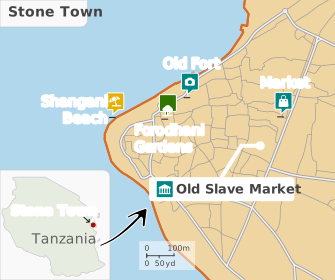
 Google Maps


Zanzibar today is famed for its sun-drenched beaches, coral reefs and atmospheric old Stone Town. For much of the 19th century, however, the island was infamous as the hub of a brutal trade that condemned
Read more
hundreds of thousands of innocent Africans to a life of slavery. No visit to the island would be complete without paying respect to the victims of this cruel trade at the former slave market, where an Anglican Cathedral built in the 1870s stands alongside the informative East African Slave Trade Exhibit.History of the Old Slave Market & Cathedral

Zanzibar’s slave trade dates back to before the 16th-century Portuguese occupation. It peaked in the 19th century under the influence of Sultan Said of Oman, who went so far as to relocate his capital to the
Read more
island in 1840. Stone Town’s notorious Mkunazini Slave Market was established in 1820, and over the next half-century more than 50,000 captive Africans passed through it annually. The main markets for these slaves were the Middle East and India, other Indian Ocean islands such as Mauritius and Réunion, and the spice plantations of Zanzibar itself.Slaves sold at Mkunazini had typically been captured deep in the African interior, then marched in chains to the mainland port of Bagamoyo before being shipped to Stone Town. The mortality rate was high: for every victim sold on Zanzibar, at least as many were murdered by slave raiders or died on the coastward march. The Zanzibari slave trade officially ended in 1873, when Britain persuaded Sultan Barghash to sign an abolition treaty and shut down Mkunazini market. Shortly afterward, the Church Missionary Society, which had been highly influential in ending the slave trade, built a cathedral on the site.-
1
Arrive at the Entrance to the Anglican Compound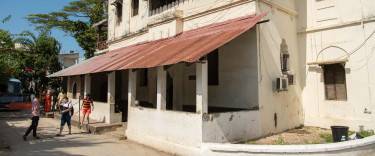
Visitors arriving at the Old Slave Market The entrance to the Anglican Cathedral is on the east side of Stone Town. Before you enter the compound, you will be frisked at the security gate. Women wearing shorts or minimal skirts will be lentRead more
a khanga (a type of colorful cotton fabric worn as a garment) to cover their knees. While you wait to be let in, look left to admire the facade of St Monica’s Lodge, a handsome double-story building that probably dates to the 1880s but has been closed for renovation for some years now.The ticket office stands just inside the security gate and is the best place to organize an optional guide, assuming you don’t have one already. -
2
Visit the East African Slave Trade Exhibit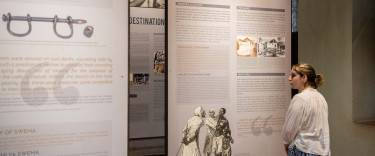
Display at the East African Slave Trade Exhibit The East African Slave Trade Exhibit is housed in a double-story mission building that was constructed as a clinic in 1877 and expanded to become a hospital in 1893. The exhibits provide an informative but soberingRead more
overview of every aspect of the 19th-century slave trade. They are illustrated with informative contemporary line drawings and black-and-white photographs.The first two panels deal with the effect of the slave trade on the East African interior: the murderous slave raids, the resulting militarization of local societies along the caravan routes, and the difficult journey from the interior to the coast. The next two panels cover the brutal conditions at the market at Mkunazini and the fate of the captives who were sold there as slaves or concubines. The final two panels cover the abolition era and the modern legacy of the slave trade. -
3
Pay Respects at the Slave Monument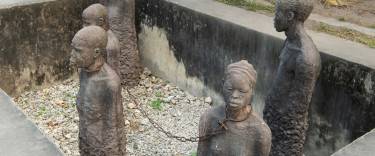
Sculpture of slaves chained in a pit A sunken pit in the courtyard in front of the Anglican Cathedral is the site of the simple but powerful ‘Kumbukumbu ya Historia ya Matumwa’ (literally ‘Memorial of the History of Slaves’) sculpted by the ScandinavianRead more
artist Clara Sörnäs. Unveiled in 1998, this affecting monument depicts five male and female captives with finely detailed and expressive faces, more roughly hewn torsos, and necks chained to each other. It is a chillingly evocative testament to the cruelty of Zanzibar’s slave trade and the inhumane treatment dealt out to its victims. -
4
Explore the Anglican Cathedral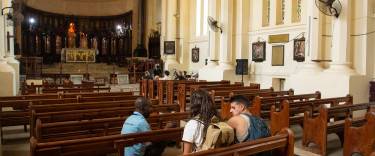
Guide with visitors at the Anglican Cathedral Officially known as Christ Church, the Anglican Cathedral was built over the former slave market between 1873 and 1880, and consecrated in 1903. It was made with crushed coral stone under the direction of Bishop EdwardRead more
Steele, a dedicated abolitionist who had worked closely with to end Zanzibar’s slave trade. A large and striking building with a tall spire on its southwest corner, the cathedral combines typical Victorian neo-Gothic features with multiple Islamic-style arches, a heavy carved wooden Zanzibari door, and an unusual barrel-vaulted roof.Inside the main entrance is a checkered marble floor with plaques honoring sailors and parishioners who died in the late 19th century. A stained-glass window evoking the end of the slave trade shows a European bishop baptizing an African woman with Islamic sun and moon symbols in the background. The cathedral’s pulpit is said to stand on the exact same spot as the Old Slave Market’s whipping post. Behind it is the tomb of Bishop Steele, who died in 1882. To its left is a small crucifix carved from wood from the tree under which Livingstone’s heart was buried in Zambia after his death in 1873.


How To Get to the Slave Market & Cathedral

The Old Slave Market and Anglican Cathedral stand on the east side of Stone Town in a district still known as Mkunazini, which translates as ‘washing place’ (prior to the 1920s, it would have stood on
Read more
the edge of a wide creek). The entrance stands on New Mkunazini Road, which can be reached by turning west from Benjamin Mkapa Road, about 150m/500ft south of Darajani Market. Most guided tours of Stone Town include a visit to the Old Slave Market and Anglican Cathedral. It is also easy to explore independently, whether you walk there or catch a taxi, but allow up to 2 hours to look around properly.Nearby Attractions

The Old Slave Market and Anglican Cathedral are often visited in combination with Darajani Market, which is only 5 minutes’ walk north along Benjamin Mkapa Road. Most other points of interest in Stone Town, including the